
Dominic Fike on "White Keys": lyrics meaning, credits, and a revealing Q&A. The story behind the song.
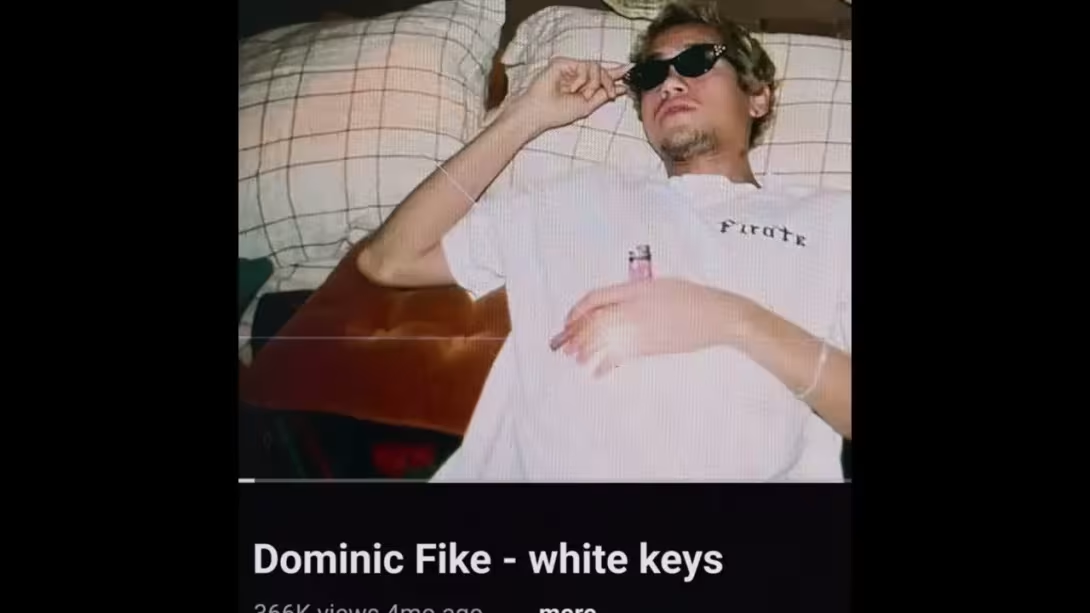
White Keys Lyrics
A'ight, pitch black Chevy antique
I was 17
I ain't have nothing
But some Tees and a pair of jeans
Palm trees
But it smell like weed in the front seat
You was en route to being famous
And everything
White keys
'Cause she's way too major for everything
I wanna be a part of it
What you got going on
Is it as sad
As you make it out to be?
I wanna be mad
But you take it out of me
1995
Teens in the Florida breeze (ooh-ooh-ooh)
Ice cream
Shit was so sweet before everything
Tight squeeze
Tryna fit me into every day (ooh-ooh-ooh)
But you never came
The world is movin'
We were never meant to stay (ooh-ooh-ooh)
But I was working on the world
I guess I thought
That if I gave you what I had (ooh-ooh-ooh)
I guess I thought
That it would work
I never knew (oh, oh, oh)
It was because of you (oh, oh, oh)
I never knew (oh, oh, oh)
Oh, I guess I never knew (whoa)
A'ight, rich ass
Tryna fit my Gs in these Prada jeans
Mismatchin' with my Celines
King of everything
Fifth stack comin' in this week
I bought everything
Dispatchin' with dollar G's
Pulled up, ripped the scene
White keys
'Cause she's way too major for everything
The kids want this
This ho want that
I feel my heart inside my back
I made a point to be intact
And you don't even keep it wholesome with me
You were singin' no songs with me (ooh)
The world is movin'
We were never meant to stay (ooh-ooh-ooh)
But I was workin' on the world
I guess I thought
That if I gave you what I had (ooh-ooh-ooh)
I guess I thought
That it would work
I never knew (oh, oh, oh, oh)
And it was because of you (oh, oh, oh)
I never knew (oh, oh, oh)
Oh, I guess I never knew (whoa)
Written by: Dominic Fike
🔗 Share/शेयर करें:
White Keys Song Description
Credits:
"White Keys" was released on November 14, 2025, and was produced by John Cunningham and Dominic Fike, with writing credits solely belonging to Dominic Fike. The song's publishing rights are held by Cunninghamster Music, Kobalt Music, Happy Monday Jr Publishing, and Sony Music Entertainment. The phonographic copyright is jointly owned by Columbia Records, Sony Music Entertainment, and Sandy Boys, with distribution handled by Sony Music Entertainment. The recording engineering was done by Brian Cruz, while the mastering was handled by Ruairi O'Flaherty. On the instrumental side, John Cunningham contributed drums and bass, and both Dominic Fike and John Cunningham played guitar on the track.
Lyrics Meaning & Analysis
Dominic Fike’s “White Keys” is a bittersweet time capsule—a nostalgic, aching look back at youth, ambition, love, and the slow realization that effort alone cannot force a relationship to work. The song oscillates between two distinct timelines: the innocent, scrappy past of being 17 in Florida, and the hollow, materialistic present of fame and riches. The title, “White Keys,” likely plays on multiple meanings: the white keys of a piano (symbolizing something pure, major-key, or “too major for everything”), the white keys on a computer keyboard (typing out messages or songs that go unanswered), or even a metaphor for the clean, untainted potential of the past before life got messy.
The song opens with a vivid, almost cinematic memory: *“A'ight, pitch black Chevy antique / I was 17 / I ain't have nothing / But some Tees and a pair of jeans.”* Fike immediately establishes a sense of poverty but also freedom—palm trees, the smell of weed in the front seat, Florida breezes. He contrasts his humble reality with the subject of the song, someone who was “en route to being famous” and is “way too major for everything.” He wants to be part of her world, but he senses a sadness beneath her glamour. The line “I wanna be mad / But you take it out of me” reveals his vulnerability; even his anger gets disarmed by her presence. The *“1995 / Teens in the Florida breeze”* and “Ice cream / Shit was so sweet before everything” are heartbreaking in their simplicity—a lost Eden before fame, before distance, before the “tight squeeze” of trying to fit into her days when she never showed up.
The chorus then elevates the song into existential territory: “The world is movin' / We were never meant to stay.” This is the core thesis of “White Keys.” Fike acknowledges that time, ambition, and the relentless forward motion of life were always working against their relationship. But despite that cosmic truth, he admits, “I was working on the world”—he was building something, grinding, trying to give her everything he had. The tragic irony is that he thought “if I gave you what I had… that it would work.” The repetition of “I never knew / It was because of you” suggests a delayed understanding: only in hindsight does he realize that she was the reason for his motivation, his pain, or perhaps the very thing holding him back. He was blind to her influence until after the fact.
In the second verse, the setting flips to the present of wealth and status: “A'ight, rich ass / Tryna fit my Gs in these Prada jeans / Mismatchin' with my Celines / King of everything.” He has all the material trappings—fifth stack comin’ in, bought everything, ripped the scene—but the relationships are transactional: “The kids want this / This ho want that.” He feels his “heart inside my back” (a visceral image of being stabbed in the back or carrying a heavy emotional weight behind him). He made a point “to be intact” (to protect himself, to stay whole), but accuses the other person: “You don't even keep it wholesome with me / You were singin' no songs with me.” The metaphor of singing together is beautiful—it represents harmony, collaboration, shared joy. She refused to sing with him. The world kept moving, and they were never meant to stay.
Ultimately, “White Keys” is a eulogy for a relationship that died not from a single fight, but from the slow drift of two people moving in different directions—one toward fame, the other trying to hold on. Fike’s production, alongside John Cunningham’s drums, bass, and guitars, wraps these memories in a hazy, melancholic warmth. The song never resolves with anger or closure. It simply rests in the confusion of hindsight: “Oh, I guess I never knew.” And that’s the most heartbreaking part of all—not the loss itself, but the realization that you never understood the loss while it was happening.
Dominic Fike on "White Keys": A Track-by-Track Breakdown
Question: Who or what is the song about? Is it based on a real person?
Dominic Fike: I always picture it as this girl Chelsea, this girl that I dated. So, it's like a letter to her, kind of. But it's weird and distorted because it's like I'm talking to her as if she's getting famous — and that didn't happen. It's kind of made up.
Question: When and how was the song created?
Dominic Fike: It was me and John Cunningham. I want to say it was late at night. That was one of the last ones we made. We made a bunch of other songs, and we liked the other ones more at first. "White Keys" seemed like I was really rowdy at the time of making it, so it felt like we weren't going to put it out. I just wasn't super in my right mind — which I think was the best part about it. You can kind of hear it with the screaming, you know? It's passionate.
Question: The opening line mentions a "pitch black Chevy antique." Was that a real car?
Dominic Fike: My older brother had a baby blue Monte Carlo named "Swank." He got it from some old lady who had redone all the interior, and it actually said "Swank" on it. I was picturing Swank — the car — when I was writing about the Chevy. I tried "bright blue" but it didn't sound as cool. Well… maybe it does. Maybe we change it? (Laughs)
Question: The line "White keys 'cause she's way too major for everything" — is that a music theory reference?
Dominic Fike: Good line, because the white keys on a piano are major keys. I was at a coffee shop once and some girl told me, "You helped me learn about music theory with white keys." And I was like, "Stop it. That's not learning about music theory." But… thank you.
Question: There's a theme in the song about fame and sadness. What were you trying to say?
Dominic Fike: When people start to try to reach for fame — everyone wants to be famous now. People just want to be seen, talked to, and heard. And it feels like the only way you're doing that now is if you have a massive following. But there's a stigma that comes with it. When you get that platform, you get to lean into being sad, you get to throw a pity party for yourself because you're experiencing all these things really fast. You feel like people are taking from you. But it's whack. And I guess I'm wishing somebody would have said this to me. Maybe that's why I was writing it — like a therapist talking to myself in 2020.
Question: The line "tight squeeze, tryna fit me into every day but you never came" — some people have interpreted that differently. What did you actually mean?
Dominic Fike: I'm strictly referring to schedules. I don't write things like that. There's no tongue-in-cheek between "coming" and the tight squeeze of anything else. That's not what I do. I really did have a problem with this. This girl worked so much. The reason we broke up was because we weren't spending enough time together. And I used to say, "Because you're always working." Which is so funny now that I think about it. Like, what a bum.
Question: Then you say, "The world is moving, we were never meant to stay, but I was working on the world." That sounds pretty bold.
Dominic Fike: Pretentious. What a crazy thing to say — to be like, "I'm molding the world with my perspective." I don't know what people think it actually means, but I think at the time I meant: I'm so righteous that what I'm doing must be having some effect on the world. I don't know. Crazy drunk DMs is a crazy guy.
Question: What about the line "I never knew it was because of you"?
Dominic Fike: I don't know. See, this is where the song is kind of… man, I was really songwriting up in there. It depends. That probably just means different things to different people if you hear it at a different time. To be real, it's one of those things. Sometimes I'm just writing stuff, and I know it doesn't make sense. And I'm like, well, somebody's going to hear it and they're going to make something out of it.
Question: The second verse talks a lot about money — Prada jeans, Celine, buying everything. Why did you want to include that?
Dominic Fike: I feel like I never really get to talk about money the way I want to in rap music. Drake gets to do it. Kendrick gets to do it. Everybody gets to do it but me, it seems. I feel like it's a rite of passage. When you start rapping and you're coming up, that's what you're rapping for — so you can be like, "I got this stuff now." And I didn't really get to do that until now.
Question: There's a line people often mishear: "You were singing no songs with me" or "old songs"?
Dominic Fike: People always mess that up, which I don't mind. They say something else about this line, and I see a bunch of kids really singing the hell out of it — and it's wrong. It's kind of cool and endearing. I'm like, "Okay, that's what it is now." I think Genius says something different. Oh my God, shout out Genius. So cool. Ben loved this shit, by the way. Always wanted to be on here.
The actual line is: "You were singing old songs with me." That's crazy. You know that song by Joe — "I Wanna Know"? Come on now. Yeah. That's so good. That's it. That's all I need. That's the best pull I could have had. That's crazy.
Source: Dominic Fike "White Keys" Official Lyrics & Meaning | Verified
Audio / Video Link